I’ve been invited to talk about how disability has featured in my research or teaching. This is in preparation for that.
This will focus mostly on how disability has featured in my research, which is primarily creative and poetry-based. But first: what happened. I got the flu in 2016 and just weeks later became bedridden, unable to read, write, speak, walk, think, or process information. I was teaching at Brown at the time. After months of medical tests, all of which came back normal, I retreated to my bed and lived, mostly silent, mostly in the dark, for months. My primary care doctor’s best guess at the time was something he called Chronic Fatigue Syndrome. I wasn’t able to learn more about it on my own, my brain had functionally stopped working, and he didn’t know much about it either. What I have since learned is that what I have, ME/CFS, is a post-viral neurological condition, affects millions, and those affected have a similar functional quality of life to people in active chemotherapy, and people with end-stage renal failure. Graphic from @chronicallyrising
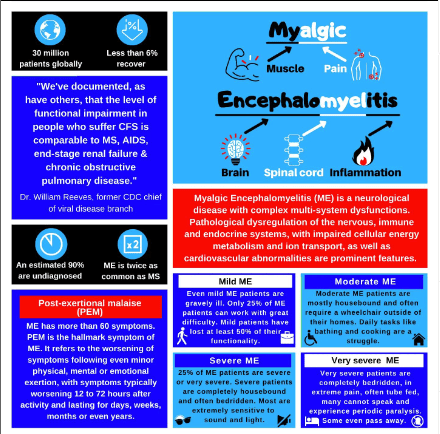
There are only a handful of experts in the world who help patients manage the condition, and there is no treatment or cure. And not to terrify anyone but about 10% of people who catch any virus (from the cold to the flu to Covid) have a long-term chronic illness triggered from the virus. Which is why disability organizers insist on continued masking not just as accessibility measures to protect the immunocompromised but also for able-bodied protection as well. I went from a young poet, in the beginning of a career in academia, to someone with one of the most severely disabling conditions in the world. Documentary film maker Jen Brea in her 2017 film Unrest on the illness calls it “the perfect prison” because, as an energy limiting illness, whatever it is that you used to do, it takes it from you.
As a poet, losing my relationship with language was devastating. As an academic, losing my cognitive capacity seemed insurmountable. Luckily, I was already reading and learning about disability liberation through the lens of radical leftist social movements, and through disability justice in my field, poetry. Turning to the educational and activism work of groups like Sins Invalid from the Bay Area, and the thinking of artist activists and educators like Johanna Hedva, author of the instrumental “Sick Woman Theory” and Leah Lakshmi Piepzna-Samarasinha’s book Care Work literally saved my life. I was especially lucky to have students at Brown where I was teaching who were actively involved in disability liberation, and with whom I could make up for the gaps in my own education on the subject.
My own work was already engaged with justice, with the political. As a third-generation Puerto Rican raised in the diaspora I was connected to the radical liberation history of Puerto Ricans and specifically Puerto Rican poets writing against injustice. But my aesthetic is somewhat more experimental, lyrical, and often research-based. When I got sick I was working on a project about cosmological darkness (dark matter and dark energy) but wasn’t quite sure what it was really about. When, several years later, I was able to revisit the project and start revising and rewriting, I realized that cosmological darkness as a signifier for that which is unknown but has measurable effect could become a metaphor for chronic illnesses like mine, where over 90% of people with it remain undiagnosed because of the lack of biomarkers and adequate research. Here’s a poem from that project.
Or, The Dark
In dreams everything looks like a memory, tinted blue, framed by the waking.
Here, the dark intricates effortlessly, as though alone: it doesn’t interact.
Holding onto a rising chord I could never keep, so familiar that each note awaits itself.
Like memory, the unmeasurable dark that keeps galaxies from spinning apart.
A body in the first form of becoming.
I couldn’t find my own dark; that difference imperceptible by touch.
A name we give to something we don’t understand.
An analogy of proximity; dark and light, what is seen and what is felt.
The sense of the end of something approaching, so I turn.
If I could retrace the steps again, hear it over and over.
Just as the sun keeps setting all the time: still greater than, and closer.
As I regained my relationship with language, several years after getting sick, I noticed my voice had changed drastically. Instead of long lines, I was using a lot of caesura, the halting pacing of my writing reflected the cognitive difficulties and fragmentation I was experiencing. I also have a practice as a book artist, which includes handmade book objects and doing book design for other poets. I have the great fortune to work with Pulitzer Prize winning poet Jorie Graham on designing her books, and as I was re-entering my poetry she was also encountering health issues of her own, which also impacted her relationship to language. Together, in short phone calls across time zones while I was living in Finland, we mourned the loss of our old poetic voices, and began to get comfortable with our new ways of writing. Our new rhythms of language and time.
Chronic, Johanna Hedva explains in her essay “Sick Woman Theory” comes from the Greek chronos:
For those who don’t know what chronic illness means: the word “chronic” comes from the Greek “chronos,” χρόνος, which means “time” (think of “chronology”). In certain contexts, it can mean “a lifetime.” So, a chronic illness is an illness that lasts a lifetime. In other words, it does not get better. There is no cure.
And there is the weight of time: yes, that means you feel it every day. On very rare occasions, I get caught in a moment, as if something’s plucked me out of the world, where I realize that I haven’t thought about my illnesses for a few minutes, maybe a few precious hours. These moments of oblivion are the closest thing to a miracle that I know. When you have chronic illness, life is reduced to a relentless rationing of energy. It costs you to do anything: to get out of bed, to cook for yourself, to get dressed, to answer an email. For those without chronic illness, you can spend and spend without consequence: the cost is not a problem. For those of us with limited funds, we have to ration, we have a limited supply, we often run out before lunch.
https://topicalcream.org/features/sick-woman-theory/
Time and energy. These are concepts we find in physics, in poetry, in art. In disability communities we talk about “crip time: the ways that disabled/chronically ill and neurodivergent people experience time (and space) differently than able-bodyminded folk.” (from the Critical Disability Studies Collective at the University of Minnesota). They are also pressing concerns in the lives of academics, of educators. Since coming to Union a lot of advice has been offered about protecting your time, making sure you have time to do research, to write. It’s heartening to be in a place where those protections are part of the regular conversation. But as someone who functions at about 1/4 of the capacity of an able body-minded person it’s often also discouraging. Everything takes me so much more time. I still haven’t finished my second book, which I’ve been writing since before I got sick. And now that I’ve exhausted my metaphor of the darkness, my poetic research has turned to time and to trees as bodies that condense time.
Just before coming to Union, I completed a poem installation at a show in Finland which took the form of a walking labyrinth. It was built to be wheelchair accessible, since I often use a wheelchair especially in the warmer months when my heart stops working as well.
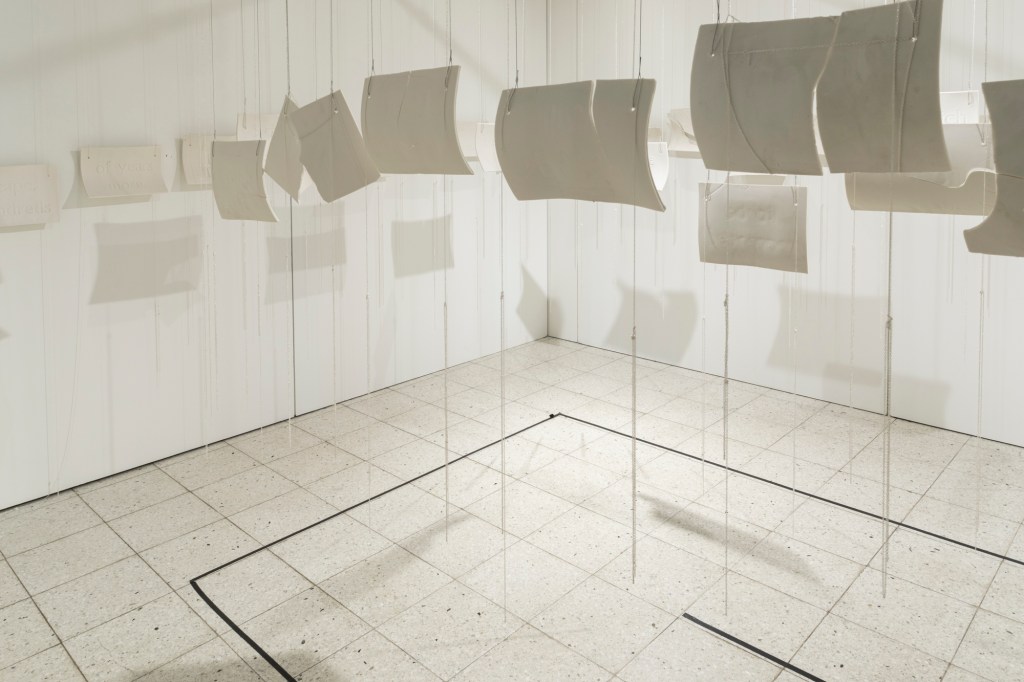
Tracing the form of a one-circut labyrinth, I printed the text of the poem from antique wooden letterpress type into plates of porcelain, which I suspended along the line of the path with silver chain. Because of my energy limitations, the plates were rolled out and made by a number of my non-artist friends and neighbors in Finland, a total of 9 people showed up over the course of a week to roll out slabs for me to print into. Becoming disabled has, in part, meant accessing and fully relying on community care networks not just for my research and production but often for daily survival. When I’m bedridden, for example, my neighbors bring me food and feed my cat.
To read the whole poem, you have to enter and complete the labyrinth. The idea was to slow down the bodymind to the pace of criptime through the action of the labyrinth. Rebecca Solnit writes in The Faraway Nearby of labyrinths: “A labyrinth is an ancient device that compresses a journey into a small space, winds up a path like thread on spool. It contains beginning, confusion, perseverance, arrival, and return. There at last the metaphysical journey of your life and your actual movements are one and the same. … In this folding up of great distance into small space, the labyrinth resembles two other manmade things: a spool of thread and the lines and pages of a book. Imagine all the sentences in a book as a single thread around a spool…imagine they could be unwound, that you could walk the line they make, or are walking it.”
A labyrinth is a way to take the longest possible time to traverse the shortest possible space. It felt like a perfect image for chronic illness time, for crip time. A handful of the plates broke in the kiln, and without the time or energy to make more, I decided to work with the broken pieces where I could.


The poem itself is about a dead tree, a tree that is very important to the village I live in in Finland, despite the fact that it has died. Through the tree I think about how we can refuse the disposability of able-bodiedness in capitalism. Here’s the poem:
All this is to say that disability has become central to my creative research and work. I have yet to incorporate it fully into my teaching, except in terms of applying accessibility practices to my class set up. I hope next year to develop a class or a reading group on criplit, but haven’t had the energy or time to do it while I’ve been teaching.
 E. Rowan Mena